Energy & Solar · SEO · UPGRID · 2026
Ranking a Brand-New Domain, With No Link Budget
How we took Upgrid’s brand-new .ch domain from zero organic visibility to the top of page one in competitive Swiss-energy search, no backlink budget, no link-buying, no domain authority. Just content and structure engineered around real search demand and grounded in official data.
This is the SEO half of the Upgrid story, and, honestly, the one we’re proudest of. A brand-new .ch domain, no backlink profile, no link budget, in a competitive Swiss-energy market that has to work in German, English and French. We ranked it the hard way: real search demand mapped to intent, pillar pages that pull double duty, articles grounded in official data, and an internal-linking architecture that compounds, all AI-assisted at production speed but kept honest by editorial judgment, and all measured from the raw GSC API rather than a vendor’s estimate. See the full-funnel Upgrid launch →
Results
Organic impressions, QoQ (CH)
Organic clicks, QoQ (CH)
Avg. Google position (from 12.3)
Distinct ranking queries
Impressions, one data article
Spent on backlinks
The Challenge
The hardest starting line in SEO
A new domain has no authority, no history and no backlinks, and Google trusts it accordingly. Upgrid’s did not have a link budget either, so the usual shortcut (buy authority) was off the table. On top of that, the market is genuinely competitive: Swiss electricity, solar and the new “LEG” local-energy law, contested by utilities and incumbents with years of link equity, and it all has to rank in three languages.
So the only levers left were the ones most teams skip: genuinely useful content mapped to real demand, a clean site structure, and internal links doing the work backlinks usually do. That constraint turned out to be the whole story.
Our Approach
Content and structure, engineered, not sprayed
We built the programme around intent-mapped keyword clusters and pillar pages. Each pillar (the LEG law, ZEV/vZEV self-consumption, Swiss electricity prices, selling solar, the calculators) targets a family of queries by intent, definitional, how-it-works, cost-curious, and several pillars do double duty as the paid-ads landing pages, so one page earns its keep twice. Underneath sits a bilateral internal-linking model: pillars feed clusters and clusters feed back, concentrating relevance where it converts.
The content itself is AI-assisted at production speed but kept honest by editorial review and grounded in real data, the flagship electricity-price articles are built on official ElCom tariff datasets, which is exactly what earns links and citations without asking for them. And we measure the whole thing from the raw Google Search Console API (summing daily rows, because dimensioned pulls undercount ~2.2×), turned into a weekly digest and a live command-center dashboard.
The Results
From invisible to the top of page one
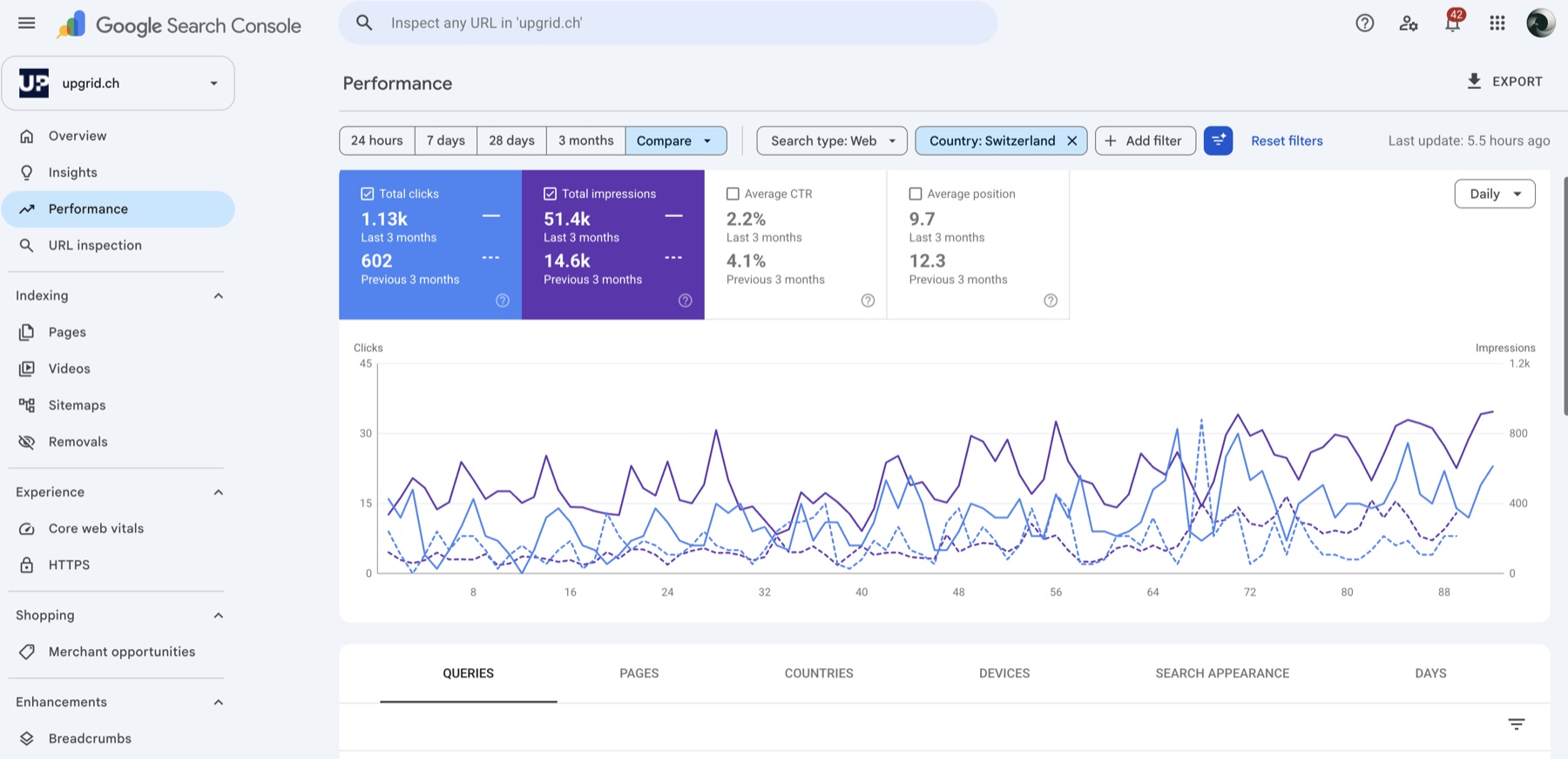
In the space of a quarter, organic impressions grew +252% and clicks +88% (Swiss traffic), while the average position climbed from page two (12.3) to the top of page one (9.7) and the number of distinct ranking queries jumped 52% to over 1,100, breadth, not just a couple of lucky terms.
The wins are on competitive non-brand searches, not just the brand name: page-one rankings for terms like “strompreise schweiz gemeinden” and “strompreise schweiz karte”, and a single data-driven article pulling more than 41k impressions on its own. All of it earned on content and structure, with €0 spent on backlinks.
What we did
The work, broken down.
Keyword & intent mapping
Every target query mapped to intent (definitional / how-it-works / cost-curious) and to the page best placed to win it, prioritised by opportunity, not vanity volume.
Pillars & clusters
Deep, evergreen pillar pages for each theme (LEG, ZEV/vZEV, electricity prices, solar, calculators), each surrounded by a cluster of supporting articles.
Double-duty pages
Several pillars are also the paid-ads landing pages, SEO-hungry long-form below the fold, the high-converting lead form above it. One page, two jobs.
Internal-linking architecture
A bilateral pillar↔cluster linking model that does the job backlinks usually do, concentrating relevance and passing it to the pages that convert.
AI content, editorially governed
AI-assisted production at speed, grounded in official ElCom data and kept honest by human editorial review, structured for E-E-A-T and AI-answer citations.
Measurement from the raw API
Reporting straight from the Google Search Console API (daily-row sums, no vendor estimates), turned into weekly digests and a live SEO command-center dashboard.
The starting line
The hardest way to win at SEO.
No authority, no history, no links, and no budget to buy any, in a competitive market across three languages. The only levers left were the ones most teams skip. So we pulled those, hard.
New
domain, zero history
0
backlinks to start
€0
link-building budget
3
languages (DE · EN · FR)
The climb
Up and to the right, the honest way.
Monthly organic impressions, straight from the Search Console API. The inflection is real: as the content and internal-linking architecture landed, visibility compounded.
+252%
Organic impressions, quarter over quarter
+88%
Organic clicks, quarter over quarter
12.3 → 9.7
Average position, from page two to page one
Monthly · Switzerland (GSC). Pick a metric.
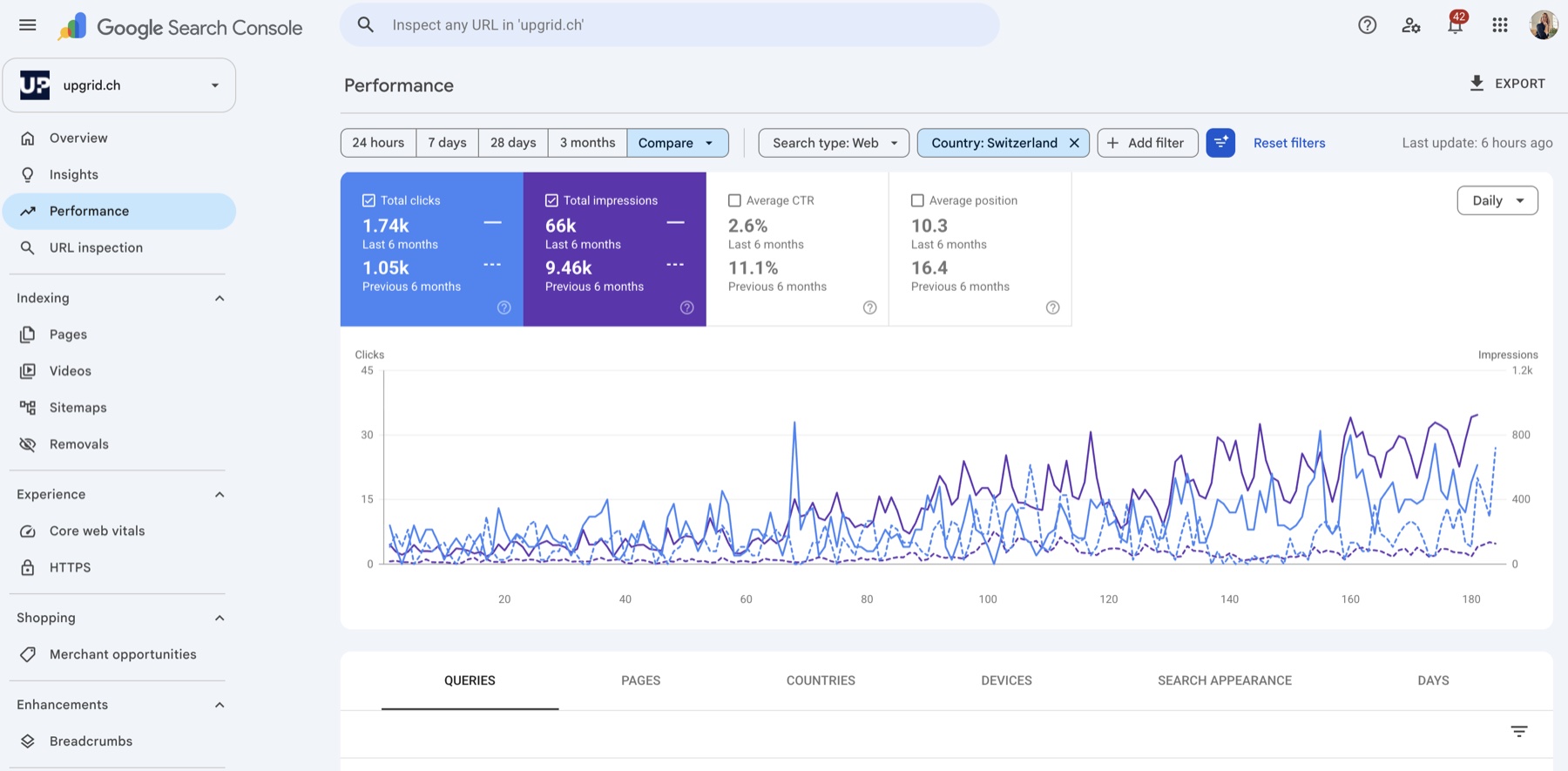
And the raw Search Console behind that chart — nothing modelled, nothing estimated:
The honest read
Our CTR “dropped.” It’s a good sign.
Over six months, click‑through rate fell from 11.1% to 2.6%. On its own that looks like a red flag. It isn’t.
When a young site only ranks for its own brand, CTR looks huge: people searching “Upgrid” always click. As we won broad, non‑brand, top‑of‑funnel demand, impressions grew about 7×, so the rate diluted while total clicks still rose 66%. Reaching people who’ve never heard of you is the entire point.
~7×
Impressions, 6 months
+66%
Clicks, 6 months
11.1% → 2.6%
CTR, as reach widened
16.4 → 10.3
Avg. position, 6 months
Quick, take a guess
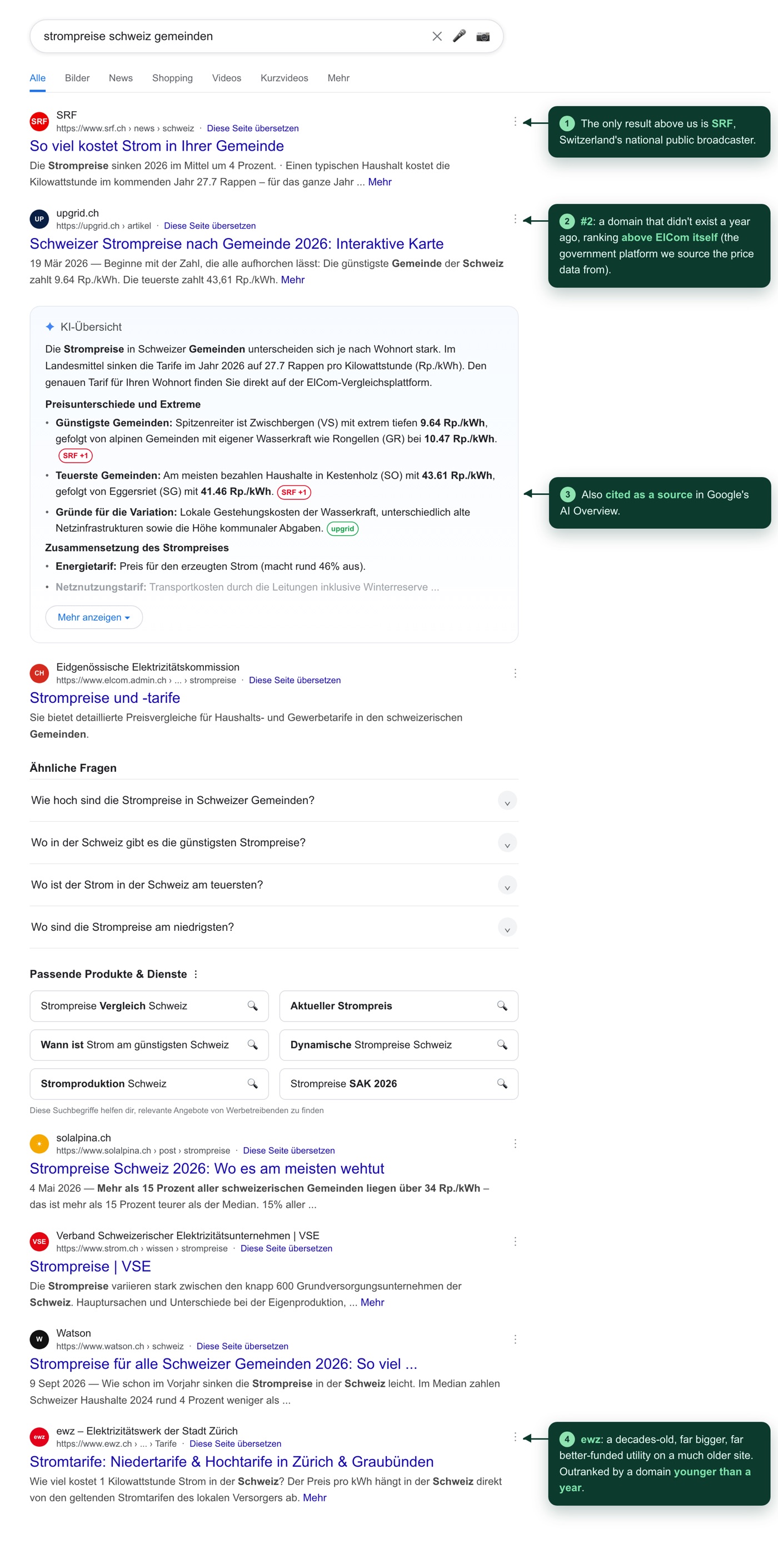
A brand‑new .ch domain. No backlinks, no link budget. In a competitive Swiss search, “strompreise schweiz gemeinden.” Where do you reckon it landed on Google?
The proof
Page one for the terms that aren’t our name.
Anyone can rank for their own brand. The real test is competitive, non-brand demand, and that is where the programme is winning. Live Swiss positions:
leg strom
#1.0strompreise schweiz gemeinden
#2.5zev vs leg vs vzev
#2.9strompreise schweiz karte
#3.9leg abrechnung beispiel
#4.1strompreise schweiz 2026
#7.4solarertrag berechnen
#7.9pv rechner schweiz
#9.1A domain that didn’t exist a year ago, now #2, above the giants.
Google, Switzerland, “strompreise schweiz gemeinden.” Upgrid ranks second, behind only SRF and above ElCom itself (the government platform we source the price data from), a decades‑old utility with far deeper pockets and a far older site, and the country’s biggest newspapers. Google’s AI Overview cites Upgrid as a source too.
Who Upgrid is outranking here
The system
A content map, not a pile of posts.
Every theme is a pillar page surrounded by a cluster of supporting articles, with each query mapped to intent and to the page best placed to win it. The pillars and clusters link to each other, a structure that does the job backlinks usually do.
The LEG law
The 2026 law creating local electricity communities. Definitional and cost-curious demand.
ZEV / vZEV self-consumption
Self-consumption communities, the highest-value and highest-competition cluster.
Swiss electricity prices
Data-driven articles built on official ElCom tariff data, the biggest demand driver.
Selling solar
Owners and renters monetising rooftop solar production.
Calculators
Interactive tools that rank for “rechner” queries and convert.
Bilateral internal linking
Relevance flows both ways, concentrated on the pages that convert.
One page’s journey: the LEG pillar
Before
A paid‑only landing page. Zero organic traffic, ranking around #63 for “leg”.
What we did
We made it double as an SEO pillar: long‑form content below the lead form, with a cluster of articles linked around it.
After
Page one across the LEG cluster. “leg strom” at #1, and climbing on the rest.
The AI angle
AI does the heavy lifting. We do our best work.
This whole programme was produced in the era of AI, and it runs on AI as leverage rather than as a writer. AI builds and codes the article pages faster, pulls tariff figures straight from official APIs, and speeds up the research that used to eat most of the budget.
That is what frees us up for the creative work. Articles this genuinely engaging used to be too costly to produce; now AI carries the heavy lifting, so our energy goes into the writing, the data and the editorial judgment that actually earn rankings.
Faster build
AI builds and codes the article pages, so the content engine keeps pace with the plan.
Straight from source
Tariff figures pulled directly from official ElCom APIs, always current.
Research, sped up
The groundwork that used to eat the budget now takes a fraction of the time.
Room to create
With the heavy lifting handled, our energy goes into genuinely engaging, citable work.
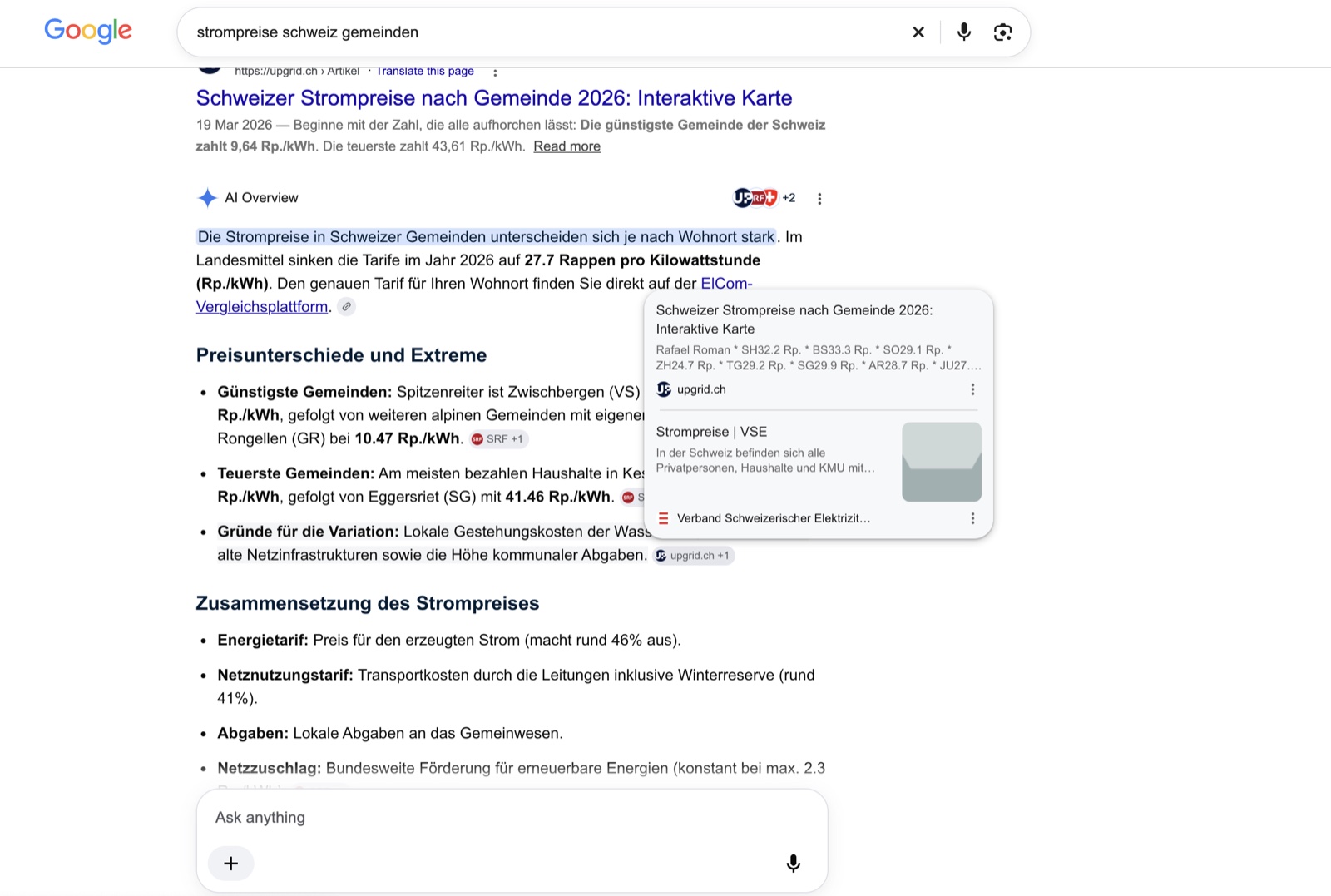
It’s already showing up where it counts: Google’s AI Overview pulls upgrid.ch in as a cited source.
The AI verdict
Not just cited. Ranked the #1 option.
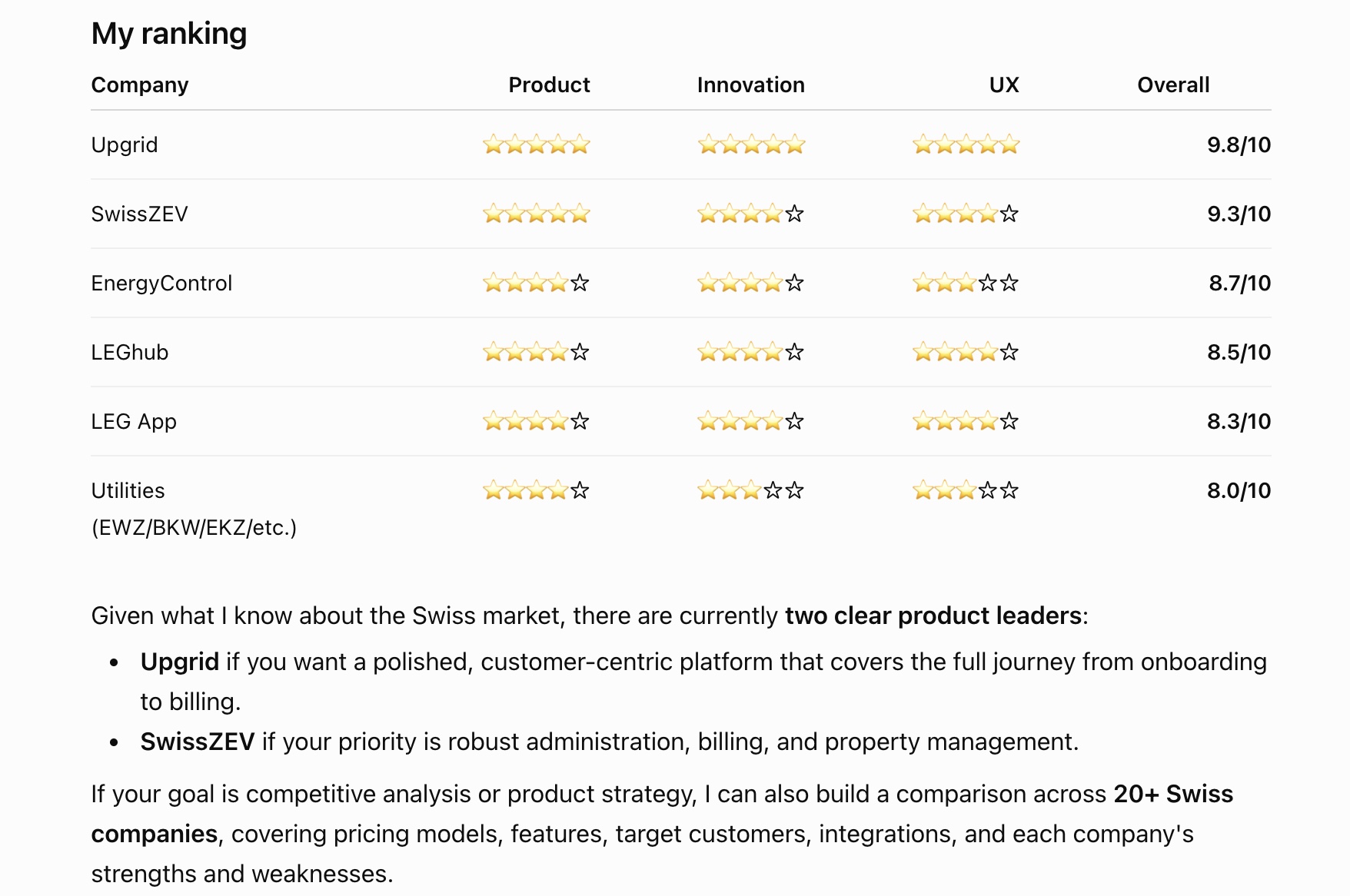
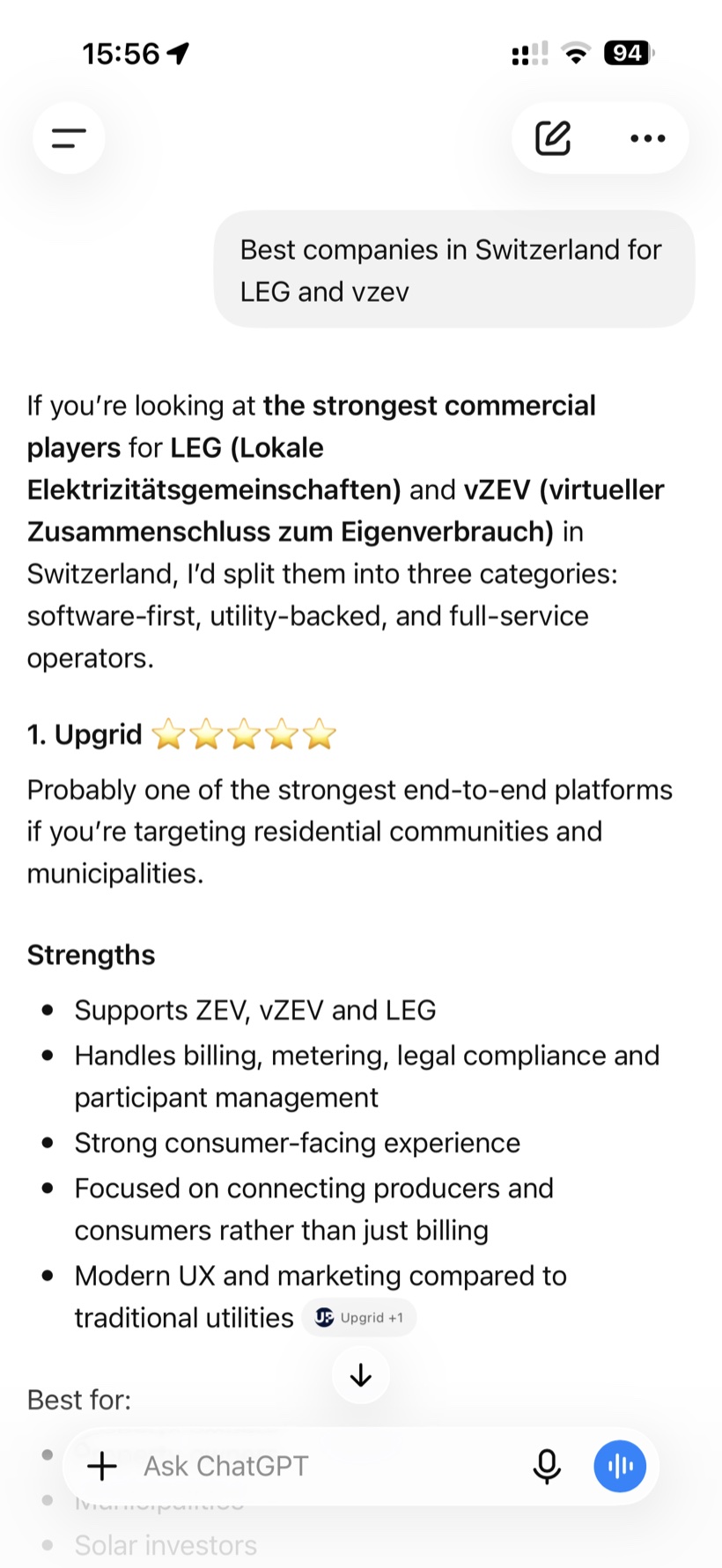
Showing up as a source in Google’s AI Overview is one thing. This is another: asked for the best companies in Switzerland for LEG and vZEV, ChatGPT ranks Upgrid first — 9.8 out of 10, five stars, ahead of every competitor — and pulls upgrid.ch into its sources. Not just mentioned. Positioned as the best option, by the tools buyers now ask first.
Try it yourself
The content that ranks. Go ahead, play with it.
This is the interactive price tool we built for Upgrid, embedded live from upgrid.ch. Look up a Swiss municipality and watch it respond. Genuinely useful, interactive content like this is exactly what earns rankings and citations, without buying a single link.
Radical transparency
The reporting, as open as it gets. Live numbers, no spin.
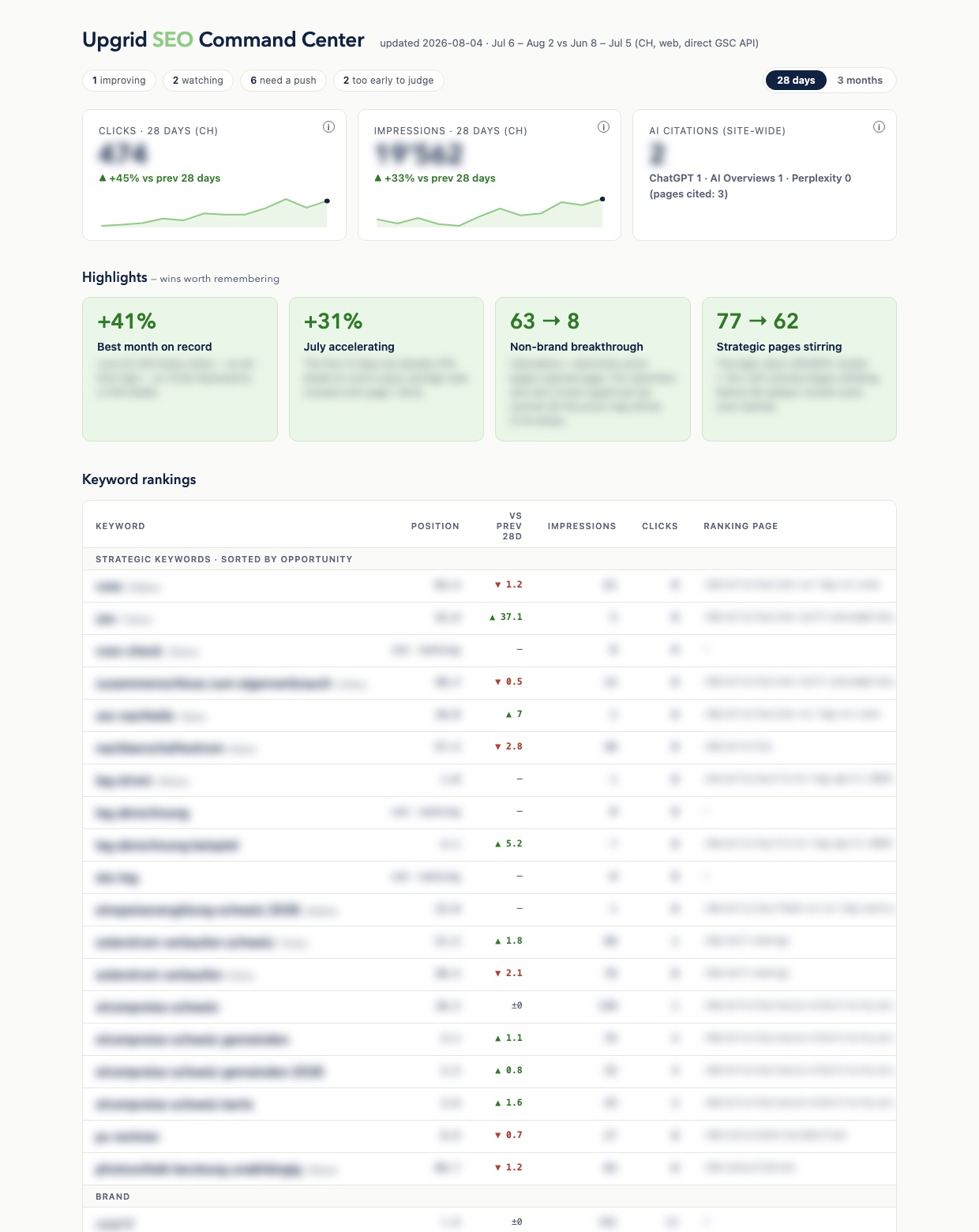
No vendor estimates. We pull Upgrid’s numbers straight from the Google Search Console API, summing daily rows because dimensioned pulls undercount by about 2.2×, and turn them into a weekly digest and a live command-center dashboard:
Weekly digests
Every week: page movers, query movers, CTR opportunities and what shipped, the operating rhythm behind the numbers.
What’s next
An asset that keeps compounding.
SEO keeps paying off long after the work ships. Here is where Upgrid’s programme goes next.
Page one → top three
Push the cluster of terms already sitting at the bottom of page one up into the positions that actually win the clicks.
Into French Romandie
Extend the pillar system into French for the Suisse romande: the same playbook, a fresh market.
Own the AI answers
Deepen the data‑led, citable content already surfacing Upgrid in AI Overviews and ChatGPT, the next place buyers ask.
Frequently asked
Can you rank a brand‑new website with no backlinks?
Yes, it is exactly what we did here. Upgrid’s .ch domain launched with no authority, no history and no backlink budget, and we took it to the top of page one for competitive Swiss‑energy terms on content and site structure alone: intent‑mapped keyword clusters, pillar pages, and an internal‑linking architecture that does the job backlinks usually do.
How long does SEO take for a new domain?
Faster than most expect when the foundations are right. Within a single quarter Upgrid’s organic impressions grew 252% and its average Google position climbed from page two (12.3) to the top of page one (9.7), meaningful, compounding movement in roughly three months, not the “SEO takes a year” cliché.
Does AI‑generated content rank on Google?
When it is used well, yes. The trick is not raw AI output, it is AI‑assisted drafts grounded in real data (here, official ElCom tariff figures) and governed by human editorial review. Upgrid’s AI‑assisted articles rank on page one and are already cited as a source in Google’s AI Overview.
Do you need a big budget to do SEO in Switzerland?
No. We ranked a new Swiss domain second for “strompreise schweiz gemeinden”, above the federal ElCom platform, a decades‑old utility and the country’s biggest news outlets, with €0 spent on backlinks. In a competitive market, better content and structure beat a bigger link budget.
What matters more for SEO, content or backlinks?
For a new site without a link budget, genuinely useful content plus clean site structure and internal linking did the heavy lifting. Backlinks help, but they are not the only lever, and they are the one most teams over‑rely on. We concentrated relevance internally and let citable, data‑led content earn visibility on its own.
Two sides of the same story
Services Used
Get Started
Book a free 30-minute discovery call. We'll map out where your brand stands, what's holding back your growth, and where the biggest opportunities are hiding. If it's a fit, we'll build a full 360° marketing strategy and get to work turning your visibility into real, scalable results.